X

I'm here to help you discover how our Agentic platform can boost your revenue, enhance the guest experience, or save your staff time on manual tasks.


There's a moment at nearly every live event that every fan knows well: you're in your seat, hungry, and you have no idea where to find what you actually want to eat. You pull out your phone, poke around a stadium app, and either get lost in a static menu or give up and settle for whatever's closest.
That experience, the gap between what fans want and what they can actually find, is exactly the problem Satisfi Labs built its Food & Beverage Agent to solve.
General-purpose chatbots and basic FAQ bots aren't built for the complexity of a live venue's food and beverage operation. On the surface, "where can I get a hot dog?" seems like a simple question. But answering it well requires a lot more than a list of menu items.
A truly helpful F&B answer needs to factor in where the fan is sitting, which nearby stands carry that item, whether the fan has dietary restrictions, and even whether that stand sells multiple items the fan's group might want. Stack on top of that the sheer variety of a modern stadium menu, including dozens of stands, hundreds of items, rotating specials, brand-name vendors, and it becomes clear why generic AI tools consistently underperform in this context.
Dietary and allergen needs are a particularly sharp pain point. If a fan asks "do you have anything gluten-free near me?", a standard bot might surface items without any verified dietary tagging, creating a frustrating or even unsafe experience. The right answer isn't a guess. It's a strict filter: if an item isn't explicitly tagged as gluten-free, it shouldn't appear in the response.
Satisfi Labs' F&B Agent is purpose-built to handle this complexity, with proximity-based search, strict allergen and dietary filtering, multi-item discovery, category tagging, and stand-level awareness all working together.
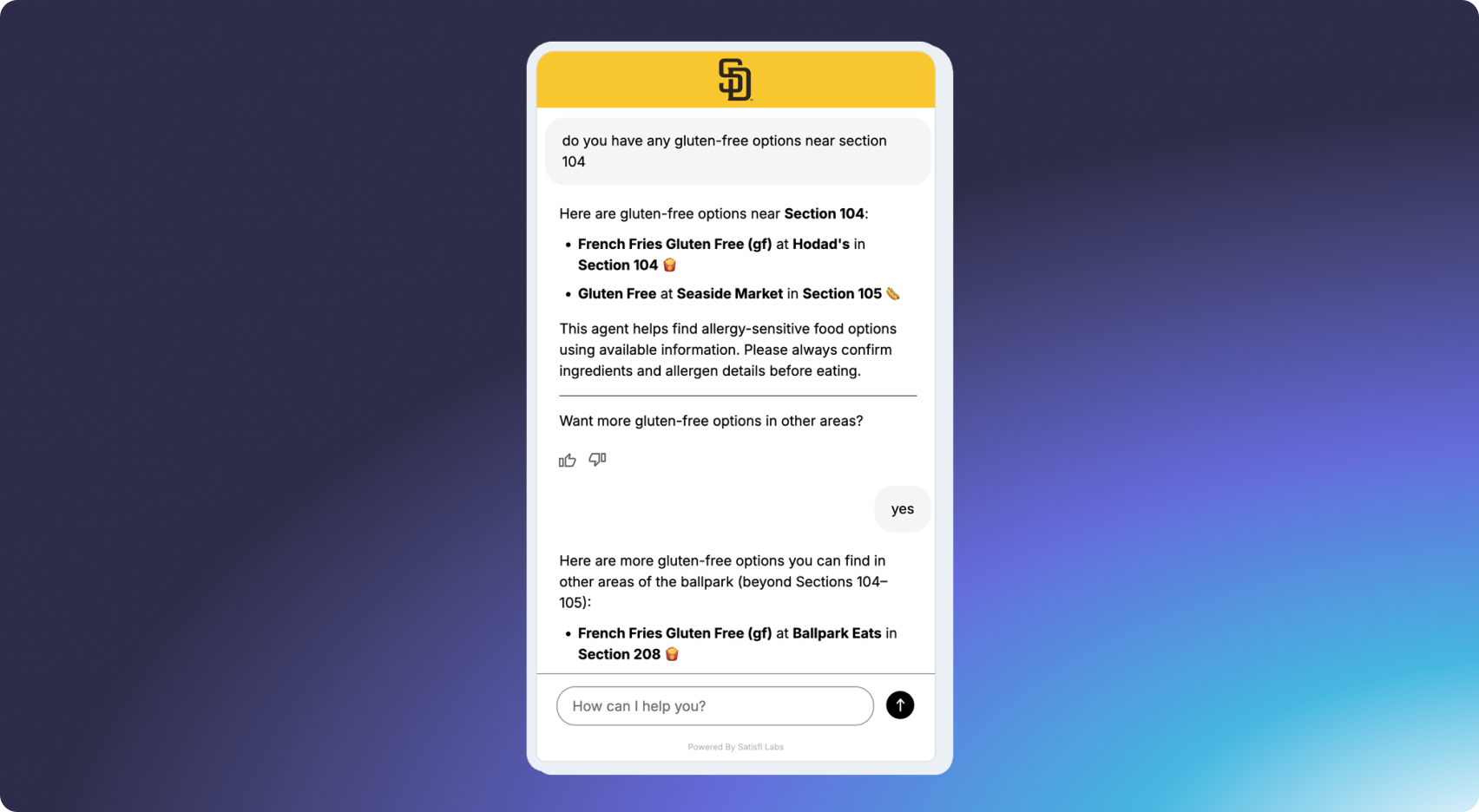
The F&B Agent's proximity-based search is one of its most impactful features. Rather than returning a generic list of menu items, the agent first surfaces the best matching food items, then prompts fans to share their section or suite for closer and more tailored recommendations. It also maintains search history within a session, so if a fan follows up with a different question, the agent already knows their location.
The data backs this up clearly. Among venues running the standard F&B Agent, 11% of conversations start with a location-based request ("where can I find X?"), compared to just 4% at venues without an F&B agent at all. That's nearly a 3x lift in fans actively trying to navigate to food, not just browse. And when fans do browse first, they follow through: 1 in 10 discovery conversations ("do you have X?") converts to a location query at F&B Agent venues, versus just 1 in 50 at non-agent venues.

The agent applies strict filtering for allergen and dietary restrictions, including but not limited to gluten-free, dairy-free, vegan, vegetarian, nut-free, kosher, and halal. If an item doesn't carry an explicit tag confirming it meets a given restriction, it won't be surfaced. The agent also appends a responsible disclaimer reminding fans to confirm ingredient details before eating, a small but meaningful touch that builds trust.
One underappreciated advantage of a dedicated F&B Agent is how much more of the menu it exposes to fans. Venues leveraging the F&B Agent surface 25% more unique menu items per company in a given period, expanding visible menu variety and driving more opportunities for sales.
.png)
Beyond single-item lookups, the F&B Agent understands category-level requests ("anything grab-and-go near me?"), brand-name searches ("do you have Rita's?"), and multi-item queries ("where can I get both pizza and a hot dog?"). This last capability, finding a single stand that satisfies a group with different cravings, is the kind of nuanced, real-world use case that generic bots routinely fail to handle.
One of the most valuable things the F&B Agent does is not just help fans find food, but generate a continuous stream of insight about what fans actually want. This is a signal that venues and operators simply didn't have before.
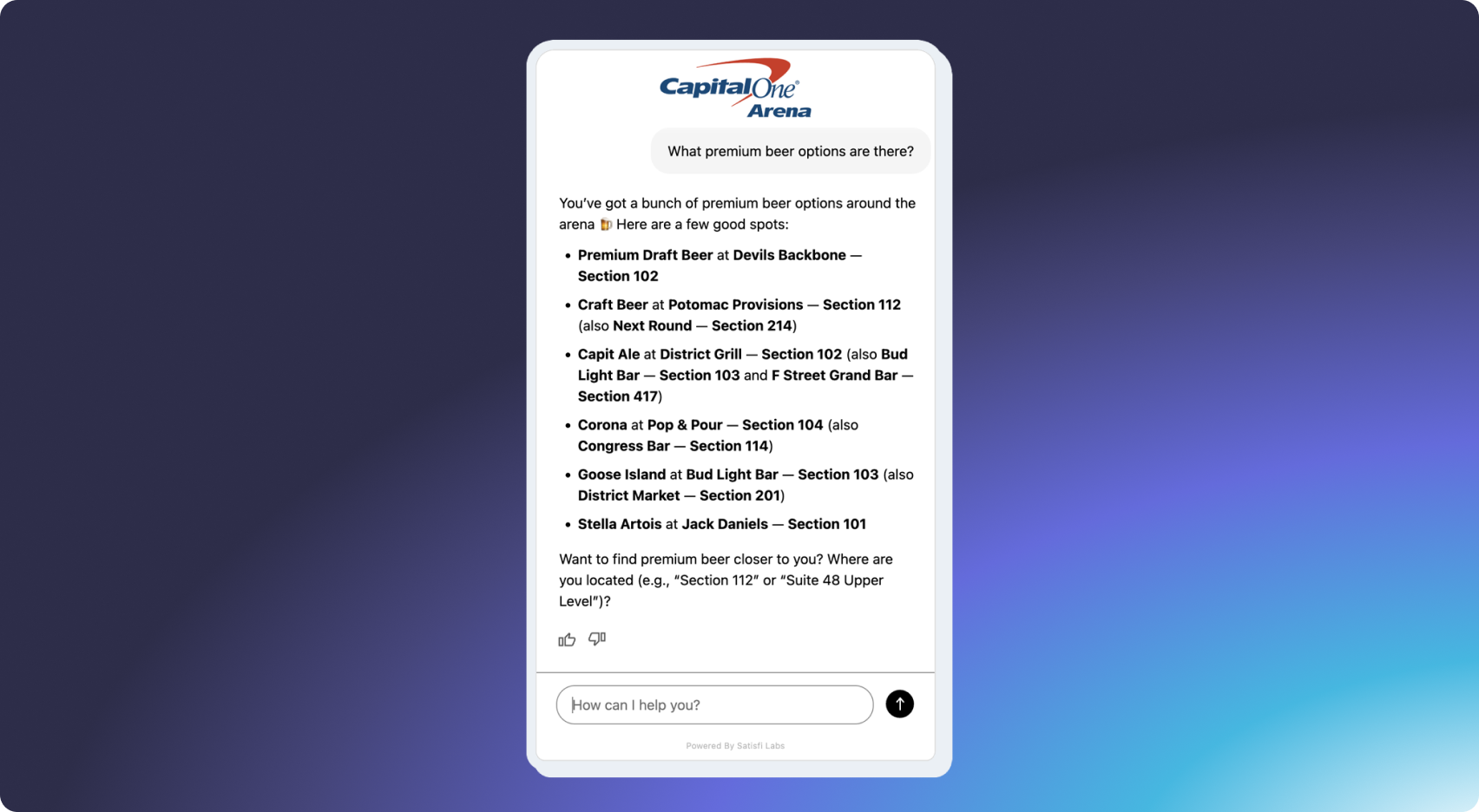
The top requested items at F&B Agent venues are premium beer, pizza, and pretzels, reflecting both the classic stadium experience and an appetite for elevated options. Alcohol-related queries account for about 12% of F&B conversations at standard agent venues, which represents meaningful sponsorship and upsell intelligence for operators.
But aggregate trends only tell part of the story. The F&B Agent is equally valuable for the items that are venue specific. During the San Francisco Giants’ 2026 Opening Series at Oracle Park, the single-most searched item wasn’t beer or pizza: it was the Crazy Crab Sandwich, generating nearly 1,000 queries. Fans also came to the agent looking for Garlic Fries, Ghirardelli Sundaes, and Birria Grilled Cheese, a lineup that reflects the culinary identity of the Bay Area, not a generic stadium menu. The F&B Agent doesn’t just improve the fan experience, but also helps concession operators know exactly which iconic, venue-specific items their fans are hunting for the moment they walk through the gates.
The split between discovery intent and location intent is also telling. At non-agent venues, nearly 80% of F&B questions are of the "do you have X?" variety, meaning fans do not even know if the item exists. At venues where the F&B Agent is active, that drops to around 64%, while location-based queries jump. Fans are moving faster from curiosity to action, because the agent gives them the confidence that the item is there and tells them where to go to get it.
This shift, from passive browsing to active navigation, means more fans are actually finding what they want and going to get it.
The F&B Agent isn't a chatbot that answers menu questions. It's a purpose-built tool for understanding fan intent, reducing friction in the food-finding experience, and giving operators the kind of real-time demand signal that static menus and receipt data can't provide.
The data tells a clear story: when fans have a smarter way to find food, they engage more, explore more, and navigate with greater confidence.
The future of the fan food experience is contextual, dietary-aware, and location-smart. The F&B Agent is already there.


