X

I'm here to help you discover how our Agentic platform can boost your revenue, enhance the guest experience, or save your staff time on manual tasks.


When a city hosts the FIFA World Cup, the pressure doesn't start on match day. It starts months earlier, in the form of inquiries, planning questions, and a global audience that expects instant, accurate, multilingual answers about getting around, where to stay, what to eat, and what to do between games.
For destination organizations, this creates a familiar problem with unfamiliar scale. Staff can't triple. Call centers can't absorb millions of conversations. Static web pages can't be personalized. And first-time visitors, especially international ones arriving in a city they've never seen, need guidance that's fast, specific, and available at 2am in a language that isn't English.
For Greater Miami and the Beaches, the preparation for that moment started long before any match was scheduled.
Greater Miami has long been ahead of the curve when it comes to serving visitors digitally. The AI agent has been a constant presence across the destination's channels, handling questions year-round and across every kind of traveler. What 2026 has given the destination is something more valuable than readiness: a detailed, real-time picture of exactly how visitors behave, what they ask, and when.
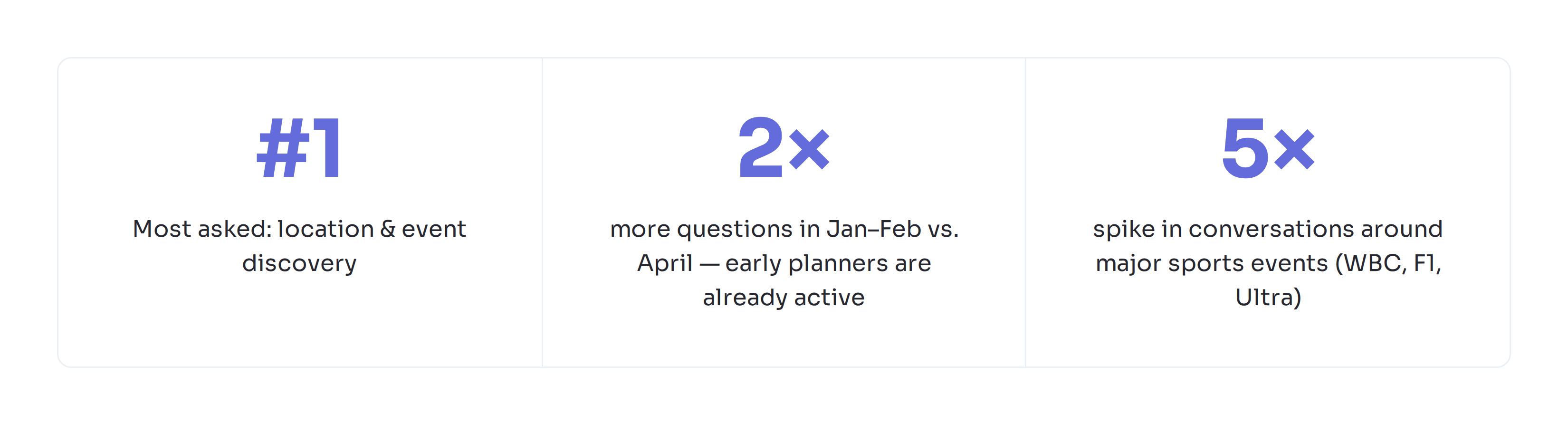
The data tells a clear story. Engagement peaked in January and February, running more than twice as high as the quieter weeks in April, driven by early trip planners getting ahead of the season. When major events arrived, conversations spiked up to five times the weekly baseline. The World Baseball Classic, Formula 1 Grand Prix, and Ultra Music Festival each generated concentrated bursts of questions about venue food, transportation, hotel logistics, and ticketing, all hitting simultaneously, all in real time. Each of those moments sharpened the picture of what visitors need and when they need it.
FIFA match days will look exactly like all of them at once, just at a much larger scale. And Greater Miami already knows what to expect.
"The FIFA World Cup 2026 is definitely top of mind for us as we get ready to welcome fans from around the world. Planning is well underway across the destination, and we are working closely with the Miami Host Committee, local partners, and industry stakeholders to make sure visitors have the information and resources they need before and during their trip." — Jesse Bergeron, Marketing Programs Specialist, Greater Miami & Miami Beach.
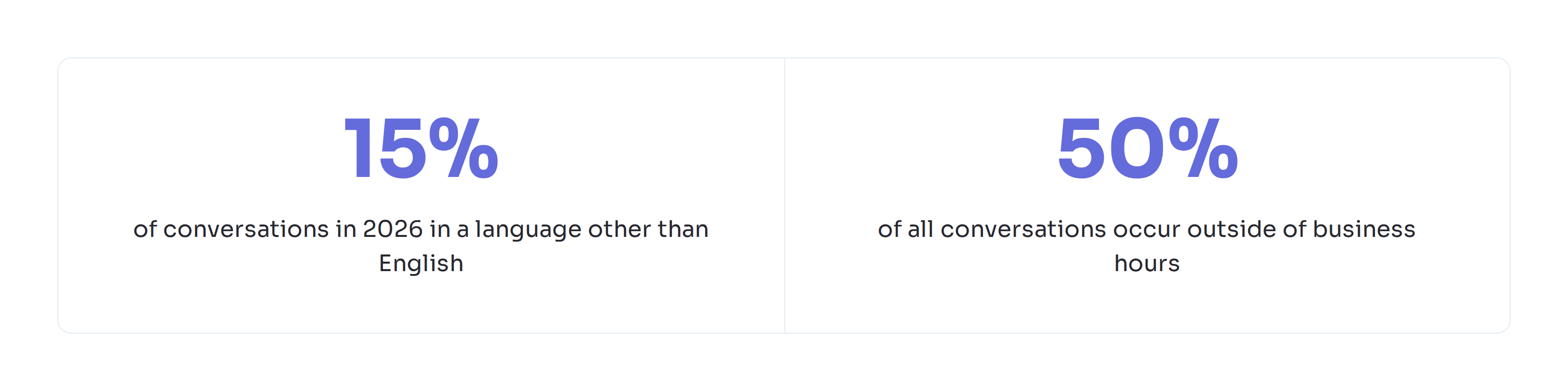
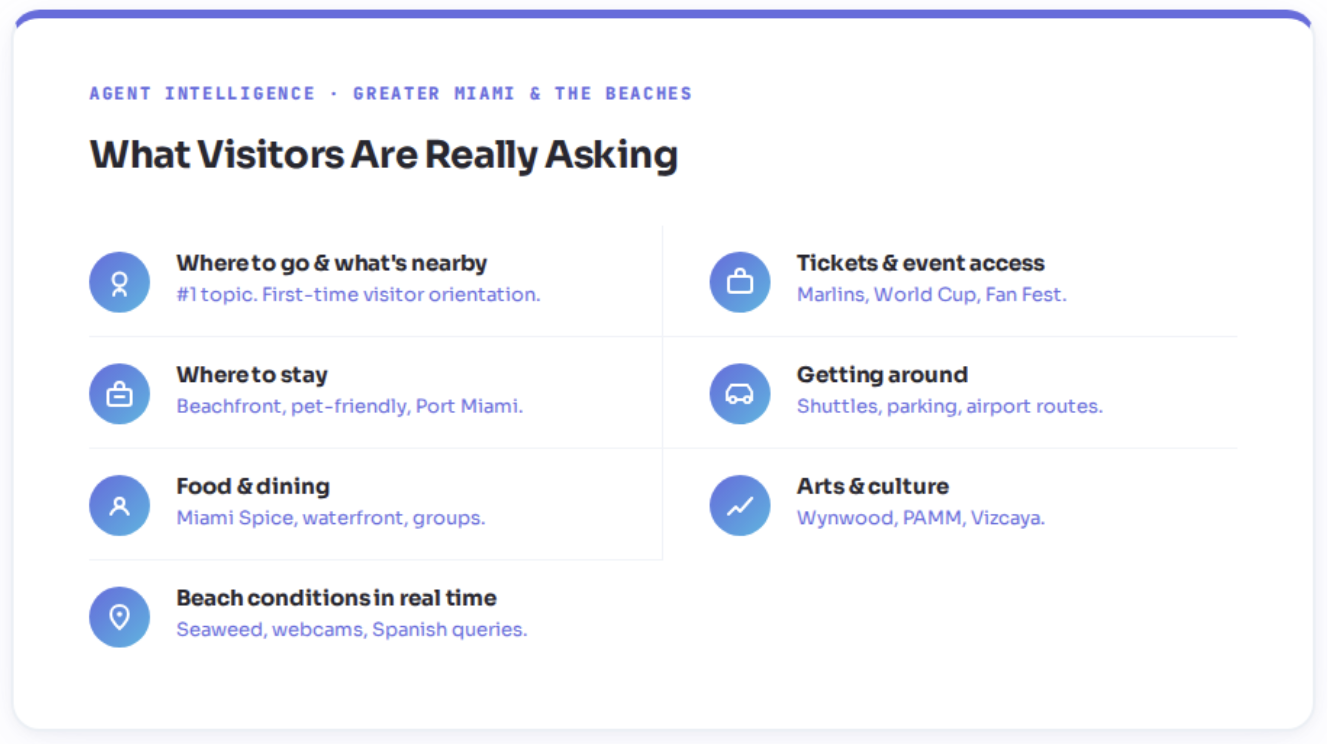
The agent data from early 2026 is essentially a preview of the FIFA visitor experience. Location and event discovery is the single most common category: first-time visitors trying to orient themselves in a city they've never navigated. Ticket and event access questions are a constant thread, from Marlins games to watch parties to World Cup match inquiries. Hotel requests are specific and revealing: beachfront with a spa, pet-friendly options, proximity to Port Miami, walking distance to the convention center. Transportation questions cover everything from free shuttle routes to overnight parking for groups of a thousand. 50% of all conversations occur outside of business hours.
15% of all conversations in 2026 came in a language other than English: Spanish leading by a wide margin, followed by French, German, Italian, and Portuguese. For a tournament where the majority of traveling supporters will come from Latin America and Europe, that multilingual fluency is a must-to-have tool.
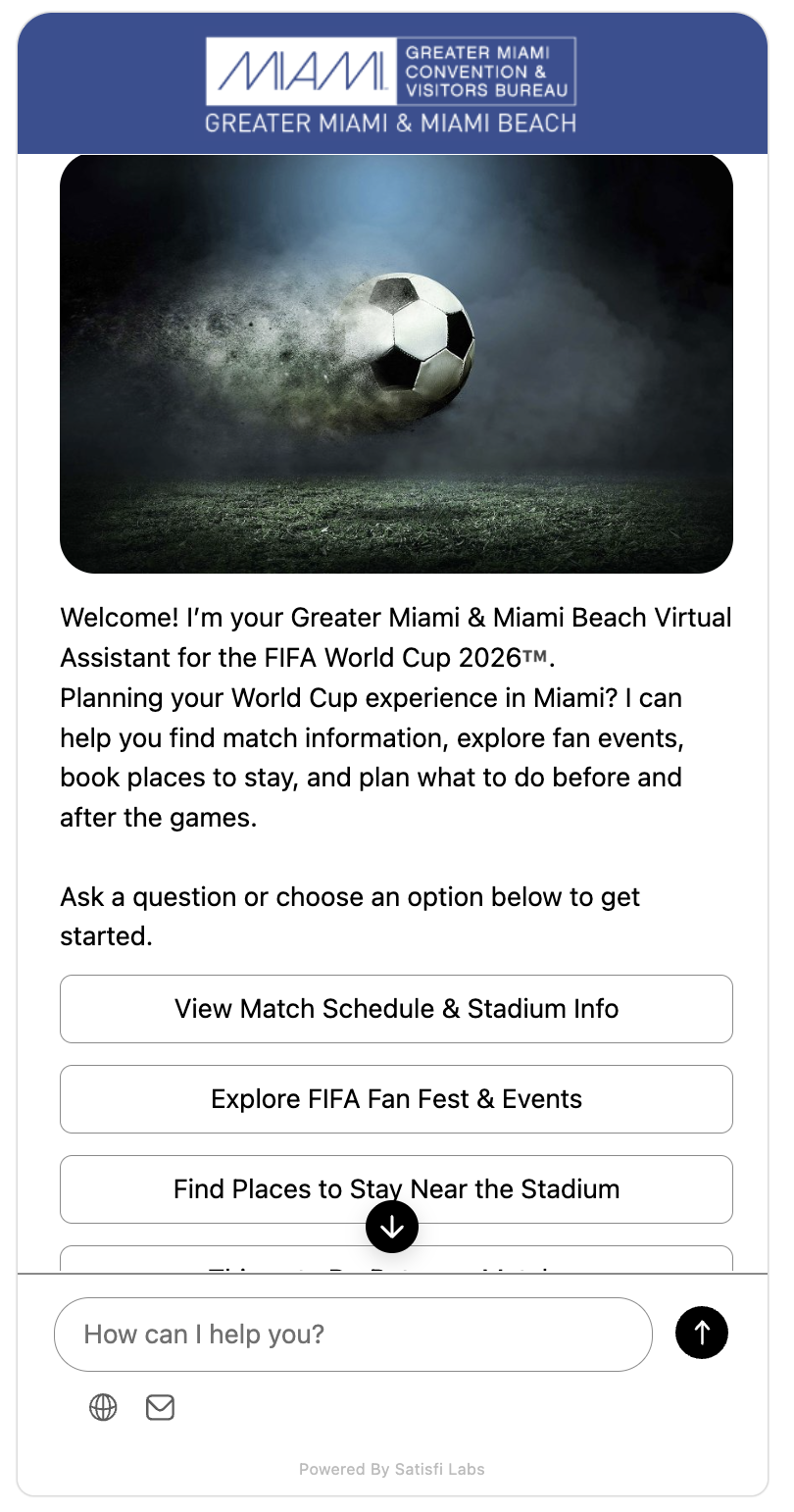
Greater Miami's approach goes well beyond making sure the AI agent can answer "what time does the match start." The agent is being built out with dedicated FIFA World Cup 2026 content: Fan Fest activities, events, deals, neighborhood guides, and transportation information, so visitors can plan their time in the city, not just their time inside the stadium.
"Our agent will be an important tool for helping visitors make the most of their time in Miami," Jesse explained. "The goal is to make it easy for fans to find things to do, places to go, restaurants, neighborhoods, attractions, and special offers while they are here. By providing personalized recommendations and real-time information, we can help visitors discover more of the destination and support local businesses throughout their stay."
That last part matters. One of the biggest economic opportunities of a tournament like this is the hours between matches. The fans who find a great restaurant in Wynwood, stumble into a gallery in the Design District, or take an evening boat tour because an AI agent surfaced at the right moment. The data from 2026 already shows visitors asking about arts and culture, beach experiences, dining, and things to do with their families: the full sweep of a Miami trip, not just a soccer trip.
What sets Greater Miami's FIFA readiness apart is that it is not a sprint assembled in the final weeks. The destination has been working with the Miami Host Committee and tourism partners to collect and surface relevant programming, deals, and experiences across every digital channel, including the AI agent, events calendar, FIFA landing page on MiamiandBeaches.com, and deals platform. Content is structured, regularly updated, and built to be readable by both visitors and the AI tools they increasingly use to plan travel.
"The FIFA World Cup 2026 is a once-in-a-generation opportunity to showcase Greater Miami and Miami Beach to a global audience," the team said. "We are making it easy for visitors to discover everything Miami has to offer and encouraging them to explore beyond the stadium during their stay."
When 64,000 fans walk out of Miami Stadium after the final whistle, they will have the rest of the night ahead of them, and in many cases the rest of the week. Greater Miami will be ready to tell every single one of them exactly what to do with it.


