X

I'm here to help you discover how our Agentic platform can boost your revenue, enhance the guest experience, or save your staff time on manual tasks.


Should you build or buy AI agents?
For most sports teams, venues, attractions, and destinations, buying can get you live faster and give you a foundation that's already built for your industry. Building can make sense if AI is the product you sell, you have a strong engineering team to own it long term, or you have a use case that requires complete control.
We'll be upfront: we sell the buy option. So here's the honest version, including where buying falls short, where building makes sense, and what you should actually consider before making the decision.
Here's how it usually goes. A team's IT group wires an LLM to the website, and in the demo it answers "what time do gates open?" perfectly. Everyone's impressed. Then the real work starts. The agent needs to understand your business, not just answer questions. What information should it know? How should it handle ticketing questions? When and how should it upsell, and when should it hand off to a person? And how do you measure whether it actually did its job?
Then there are the systems. Single-game tickets might sit in one platform and season tickets in another. Next Friday's concert is on the arena calendar, not the team's. Parking belongs to a vendor, and group leads live in the CRM. Getting an LLM to talk is relatively easy. Building an AI agent that understands your industry, performs a specific job, works reliably for your guests, and improves over time is a much bigger undertaking.
Building isn't a bad idea. There are two scenarios where building your own AI platform may make sense. If your goal is simply to answer common questions, plenty of tools can help you build a basic chatbot without investing in a specialized platform. And if AI is core to your product, or you have a strong AI and engineering team, building in-house may be the right choice.
Just remember to account for everything after launch: security and privacy, ongoing prompt updates, conversation design, integrations, API changes, and the engineering time needed to keep everything working.
A good AI agent platform isn't just a chat window connected to an LLM. You're buying the product, infrastructure, knowledge, and experience behind the agent.
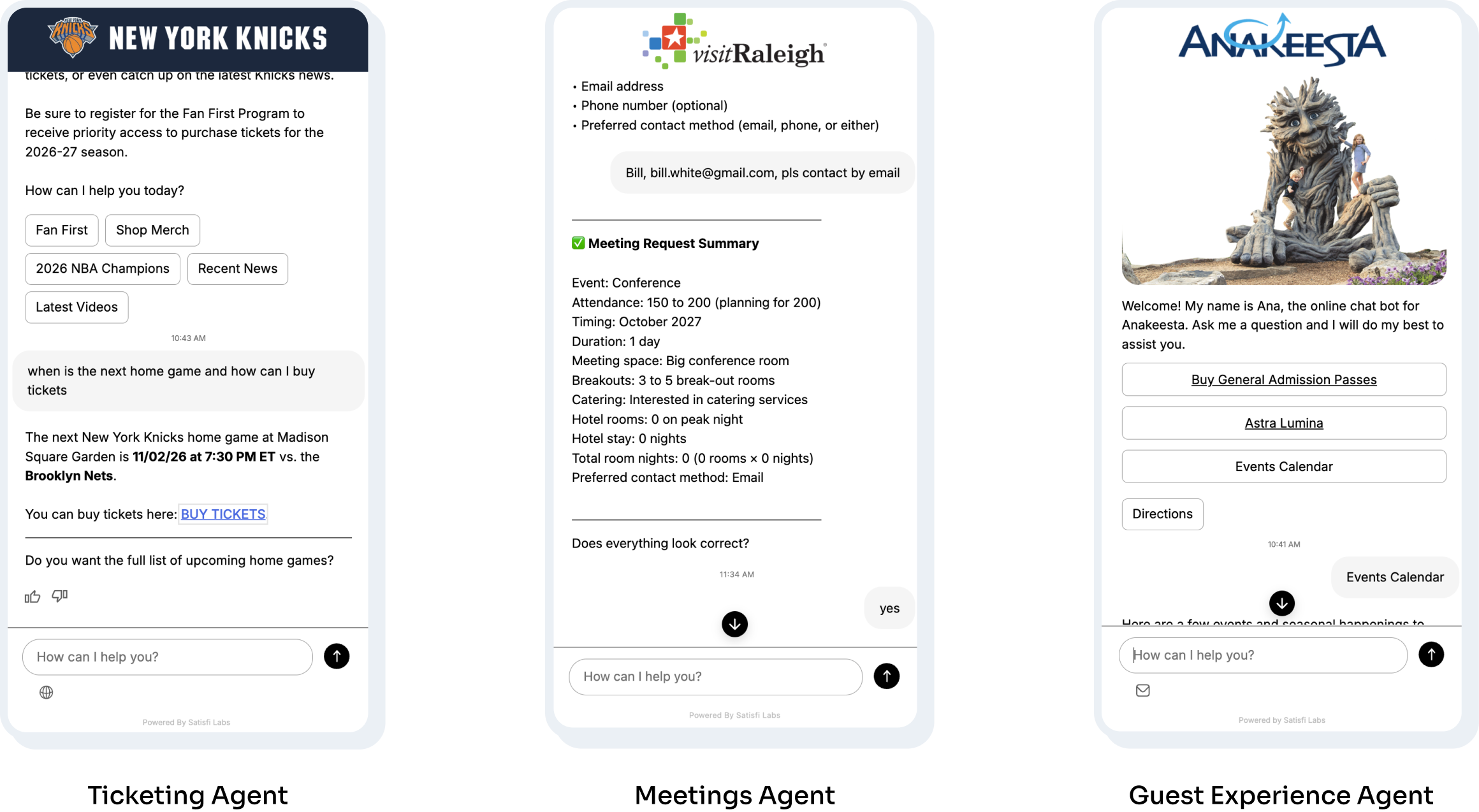
Agents designed for specific jobs. AI agents can be built around distinct business goals rather than general question-answering. For example, Satisfi Labs offers a Ticketing Agent to help guests find and purchase tickets, a Guest Experience Agent to help them navigate their visit, and a Meetings Agent to qualify event planners before they reach the sales team.
Industry knowledge built in. AI performs differently depending on the industry, audience, and business context. Years of working with sports teams, venues, attractions, and destinations help inform how Satisfi Labs designs its agents, from the conversations they need to resolve to the workflows they need to support.
Analytics built for AI performance. AI needs to be evaluated on more than individual answers. Satisfi’s Agent Performance Console measures complete conversations to assess whether guests’ needs were resolved. Teams can track performance against campaign goals, understand what guests are asking, and identify opportunities to improve resolution and revenue outcomes.
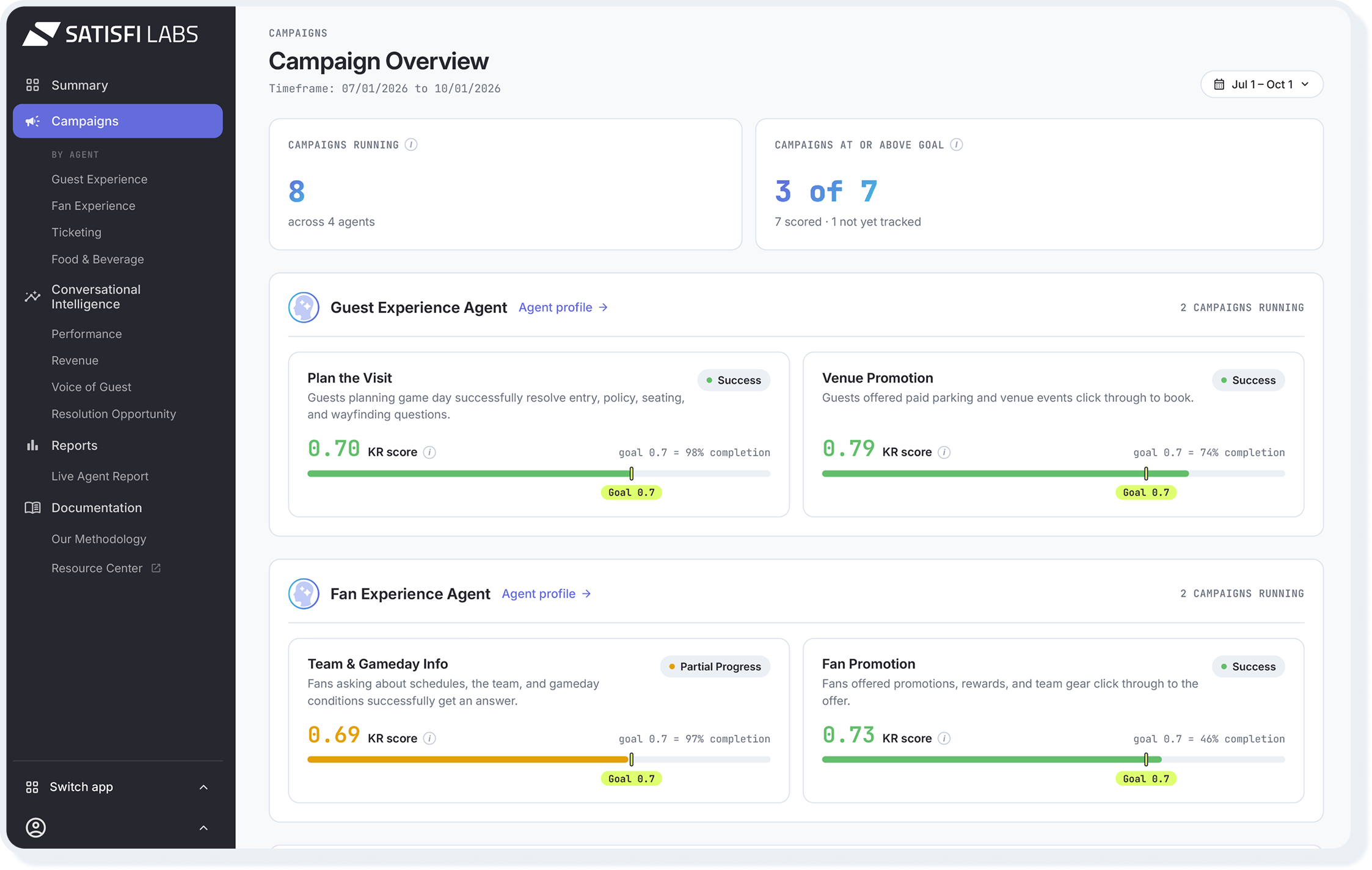
Control without a dev queue. Teams may want to manage content and messaging themselves or work with their provider to make changes. With Satisfi Labs, clients can do either, while the team handles platform updates and ongoing AI improvements.
Many teams are comfortable building internal AI tools. If an internal agent makes a mistake, a colleague catches it. A fan-facing agent speaks for your brand in public, to hundreds of people a day, so every answer it gives is your organization's answer.
Fans will ask about refunds, safety, accessibility, and topics you'd never want an AI to weigh in on. Some will try to trick it, and some will share personal information. Handling that takes guardrails, answers grounded only in your approved content, moderation, and clear handoffs to a person. Satisfi Labs builds these protections into the platform, so you don't have to design them from scratch or find the gaps after launch.
Even a specialized AI platform won't automatically know every system, workflow, data source, or business process unique to your organization. A team might sell season tickets and concerts through different ticketing systems. A tour operator might need live departure availability. A venue might have proprietary data the agent needs to access.
Connecting AI to these unique systems and workflows is often called the last mile. It's the work that turns a platform with established capabilities into something that fits the way a particular business operates. Buying a platform doesn't mean giving up customization, and it doesn't mean you need to build everything yourself.
Satisfi Forward is Satisfi's forward-deployed engineering practice, giving clients access to engineering resources for needs that go beyond standard platform capabilities. The process starts with the outcome a client wants to achieve, then connects the agents to the systems, data, and workflows needed to make it happen.
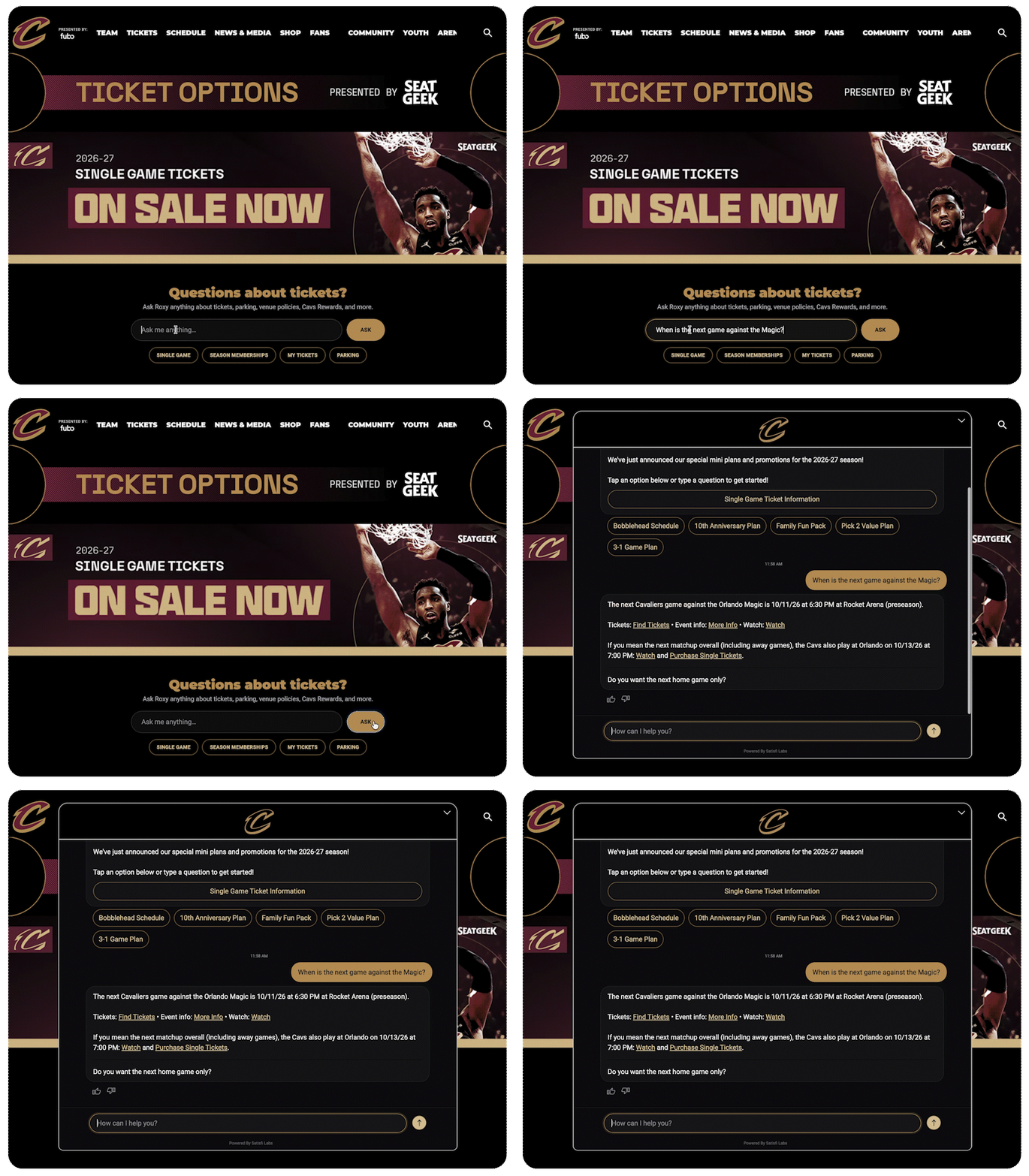
The Cleveland Cavaliers were the first Forward client. Their Ticketing Agent needed to work across the Cavaliers, Rocket Arena, their AHL affiliate, and regional sports network. Forward connected the Cavaliers’ Agent to their combined schedule, ticket types, player and matchup data, and current promotions. The team showed amazing results: 2x conversations year over year, 8 in 10 conversations now carry revenue intent, 446% more clicks to revenue-generating pages, and a significant drop (-72%) in live-agent escalations.
Building gives you control, but it also means owning the product, infrastructure, integrations, measurement, security, and ongoing maintenance. Buying can give you a head start, particularly when the platform already reflects the needs of your industry and the workflows your team wants to support.
Neither option removes the need for people who understand your business and take responsibility for how AI performs. The decision comes down to what you need to build yourself, what already exists, and whether your team is prepared to maintain the full system over time.
For sports teams, venues, attractions, and destinations, a specialized platform can provide a strong starting point, with room for custom engineering when the business requires it. That's the thinking behind Satisfi Labs and Satisfi Forward: start with capabilities built for your industry, then adapt them to the way your organization operates.


